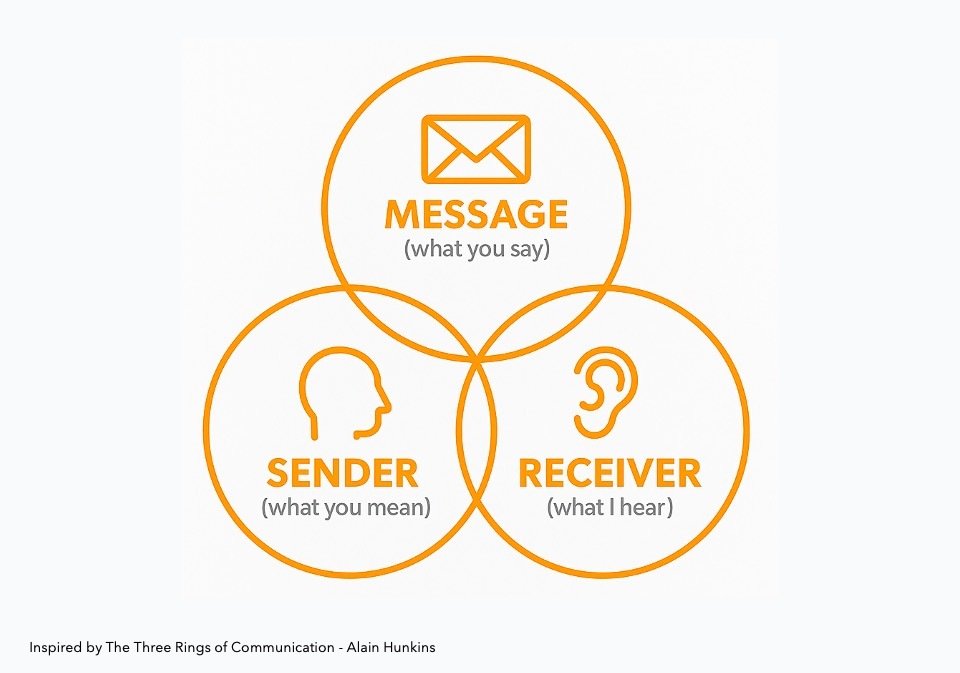
That has not changed.
What has changed is how brands show up and who is now responsible for making that happen.
Today, more marketing is handled in house. Store teams, office staff and regional managers are all producing content. AI tools sit on everyone’s desktop. Design and advertising agencies are no longer the sole guardians of the brand, they are part of a much bigger ecosystem.
So if trust is built on consistent, authentic experience, the question becomes:
How do you make brand guidelines that real people, and now AI, can actually use?
For people, trust is built over time. Make a good first impression, be understanding, build a relationship, be yourself.
For brands it is no different. You need to:
• Know who you are and what you stand for
• Understand your audience and their pain points
• Show up regularly with consistent, relevant comms
• Honour your vision and values in everything you do
The difficulty is that, unlike people, brands are expressed by hundreds or thousands of individuals. Your company vision needs to find its way into the hands, heads and keyboards of everyone who creates something on your behalf, from Head Office to the high street.
Traditionally, the answer has been a set of Brand Guidelines. Usually a PDF. Sometimes a beautiful one. Occasionally read.
Today that is not enough.
Brand guidelines now need to be:
• Easy to deploy
• Simple to understand
• Usable by non designers and non marketers
• Built for AI as well as humans
In other words, they need to behave less like a book and more like a system.
Let's talk.
FREE DISCOVERY CALL
see how we can maximise your marketing.

Classic guidelines tend to focus on the usual suspects:
• Logo and how to use it
• Colours and typefaces
• Stationery and basic layouts
More sophisticated brands extend this into:
• Tone of voice
• Photography, illustration and iconography
• Typographic styles and layout principles
Retail and franchise brands often go further with:
• Templates for point of sale
• Digital and social assets
• Local advertising formats
All of this has value, but there are two familiar problems:
- Too prescriptive, creativity dies
When every element is specified down to the size of a bullet point, people stop thinking. The moment a curveball brief appears, no one quite knows what to do, so either consistency slips or everything slows down. - Too vague, consistency dies
If the guidance is woolly, Designers and marketers go into freestyle mode. Work may be beautiful, but little by little the brand is diluted and the experience becomes fragmented, especially across multiple locations.
The trick is to provide just enough structure to protect the brand while still leaving room for intelligent creativity. Historically, that relied heavily on experienced agencies and designers who could “read between the lines”.
In an in house, AI assisted world, that is no longer a safe assumption.
In my experience, the best guidelines are exactly that, guidelines, a general rule, principle or advice. They set the boundaries, explain the why, and give specific instructions only where they really matter.
However, they also need to work for:
• A Store Manager creating a local recruitment post
• A regional marketer adapting a national campaign
• An office administrator updating a PowerPoint
• Someone using AI to write emails, socials or web copy
These people do not think in grids, leading and white space. They think in “I need a quick poster for Friday”.
So modern guidelines must:
• Remove jargon and use everyday language
• Show lots of before and after examples
• Highlight what is mandatory, what is flexible and what is for experts only
• Be searchable, scannable and available where people actually work, not buried in SharePoint
This is where templates and tools become just as important as the rules.
A lot of the commentary around EV buyers assumes they were mainly motivated by tax breaks, and that may have been true for some early adopters. But if you actually listen to EV drivers, a different picture emerges.
The Global EV Driver Survey, which spoke to more than 23,000 EV owners in 18 countries, found that:
• The top reasons for going electric were lower running costs, environmental benefits and the lack of engine noise.
• 92 per cent said they plan to choose another zero emission EV next time.
•. Only around 1 per cent said they would go back to a petrol or diesel car.
Closer to home, UK based research highlights a few under used themes:

Are your brand standards protected everywhere you show up?
Surveys of UK EV owners regularly find that once people have home charging, they do not want to give it up. In one independent survey of 2,800 EV drivers, most said they could not live without home charging, and more than half found it difficult to rely only on public chargers.
For many, the big lifestyle shift is not never going to petrol stations, it is never thinking about petrol stations.
That is a huge emotional and practical benefit we rarely build into local creative or test drive experiences.
Quiet, smooth, powerful
Drivers consistently talk about the quiet cabin, smooth response and instant acceleration as the things they would miss most if they went back to ICE.
These are feelings that work brilliantly in local content and events: city drives that feel calmer, motorway trips that feel less tiring, rural drives that feel lighter and more responsive.
Less servicing, less faff
EVs have fewer moving parts, no oil changes and less brake wear thanks to regeneration. Studies suggest they are roughly 30 per cent cheaper to service over five years on like for like comparisons, and broader analyses put lifetime maintenance costs around 50 per cent lower than for petrol cars.
That is a powerful story for aftersales departments and used EV buyers as well as new car marketing.
Once people switch, they rarely want to go back
Both global and UK surveys show very high satisfaction. EVA England’s 2024 charging survey reported that around nine in ten EV drivers had no intention of returning to petrol or diesel, despite frustrations with public charging.
So while the tax landscape is changing, the core experience that real drivers value has not. We simply have not been telling that story in a rounded way.
So what do we actually do with this as marketers, especially if we care about the local reality in real dealerships, not just national messaging?
I would focus on three practical areas.
A. Build tools, not just talking points
Front line teams need more than a briefing email.
Customer facing calculators on brand and group websites that include 3p a mile and 1.5p a mile, with presets for common driving patterns.
In showrooms and contact centres, quick tools that allow a salesperson to plug in a customer’s mileage and charging behaviour and show clear comparisons between EV, PHEV and ICE.
Simple visual leave behinds that capture the key numbers and non financial benefits in one place.
The aim is not to hard sell an EV to everyone. It is to be able to say, “Here is the full picture for you” and mean it.
B. Join up national and local messaging
If the national EV campaign still implies “cheap to run, tax break, job done” while your local teams are firefighting questions about 3p a mile, the dissonance will be obvious.
Align on a shared narrative that covers cost, convenience, drive experience and servicing, not just one dimension.
Make sure local social, email and outdoor executions pick up the same themes in local language, not just re run national creative with a Dealer logo.
This is exactly where multi location brands often fall over. The Budget gives us a reason to fix it.
C. Use AI to support consistent, confident conversations
AI is ideal for the “explain and personalise” layer of this challenge:
Turning dense Budget detail into role specific internal explainers for sales, fleet and aftersales.
Auto drafting local emails, social posts and web copy from national assets, updated with the new tax facts and the real world EV benefits owners talk about.
Powering chat journeys that can handle “what does 3p a mile mean for me?” consistently, before handing off to a person where needed.
The goal is not to hide behind bots, it is to free people up to be human, while keeping the story straight.
A closing thought
3p a mile was always coming in some form. The detail matters, but the bigger risk for our industry is that we let that one number dominate the entire story.
If we focus purely on the tax, we invite a narrow, negative debate.
If we step back and combine:
• a grown up cost conversation that includes 3p a mile and the direction of travel for fuel duty,
• with everything real EV drivers tell us they value and do not want to give up,
• then 3p a mile becomes one factor in a broader, honest value exchange.
The tax lands in 2028.
The EV story gets rewritten now.
How ready are your brand and your Retailers to have that conversation?